

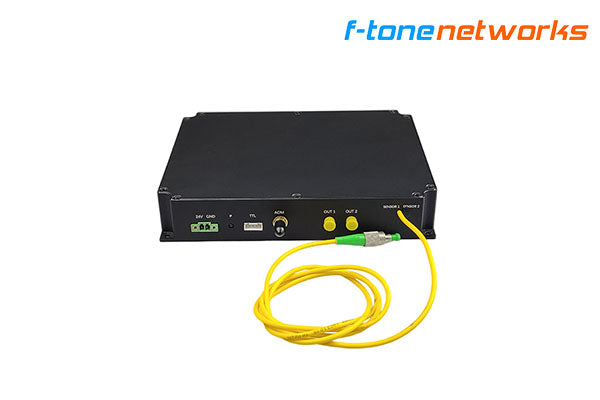
Distributed optical fiber DAS integrated module
| Module Parameters | Min | Typical | Max | Unit | Remark |
|---|---|---|---|---|---|
| Measurement Distance | — | — | 60 | km | |
| Pulse Width | 50 | — | 500 | ns | |
| Warm‑up Time | — | <10 | — | Min | |
| Operating Voltage | 4.8 | — | 5.2 | V | |
| Power | 3.5 | 9 | 15 | W | |
| Operating Temperature | -20 | — | 60 | ℃ | |
| Storage Temperature | -30 | — | 70 | ℃ | |
| Communication Interface | — | RS‑232 | — | — | |
| Communication Protocol | — | Modbus‑RTU | — | — | |
| Ultra‑narrow Linewidth Light Source | Min | Typical | Max | Unit | Remark |
| Operating Wavelength | 1530 | 1550 | 1570 | nm | |
| Output Power | — | 10 | 13 | dBm | |
| Linewidth | — | <3 | — | kHz | |
| Relative Intensity Noise | — | <-120 | — | dB/Hz | |
| Wavelength Drift | — | ±1 | — | pm | |
| Power Stability | — | — | ±2% | — | Full temperature range |
| Side‑mode Suppression Ratio | 60 | — | — | dB | |
| Pulse EDFA | Min | Typical | Max | Unit | Remark |
| Operating Wavelength Range | — | 1550.12 | — | nm | |
| Input Peak Optical Power | — | 10 | — | dBm | |
| Input Average Optical Power | -35 | -30 | — | dBm | |
| Output Peak Optical Power | — | 23 | — | dBm | |
| Output Average Optical Power | — | — | 0 | dBm | |
| Repetition Frequency | — | — | 100 | kHz | |
| Noise Figure | — | 5.5 | — | dB | |
| Polarization‑Dependent Gain | — | — | 0.5 | dB | |
| Polarization Mode Dispersion | — | — | 0.5 | ps | |
| Acousto‑Optic Modulator | Min | Typical | Max | Unit | Remark |
| Operating Wavelength Range | 1520 | 1550 | 1580 | nm | |
| Average Optical Power | — | — | 0.5 | W | |
| Maximum Pulse Optical Power | — | — | 0.5 | kW | |
| Insertion Loss | — | 2.5 | 3 | dB | |
| Extinction Ratio | 50 | — | — | dB | |
| Rise/Fall Time | — | — | 30 | ns | |
| Frequency | — | 80 | — | MHz | |
| VSWR | — | 1.2:1 | — | — | |
| Input Impedance | — | 50 | — | Ω | |
| RF Power | — | 2.5 | — | W | |
| Frequency Shift | — | 80 | — | MHz | |
| Raman Amplifier | Min | Typical | Max | Unit | Remark |
| Laser Wavelength | — | 1455 | — | nm | |
| Output Power Range | 25 | — | 27 | dBm | |
| Balanced Detector | Min | Typical | Max | Unit | Remark |
| Bandwidth | — | 80 | — | MHz | |
| Gain | — | 80 | — | kV/A | |
| NEP | — | — | 30 | pW/√Hz |
Professor Wu from F-tone Networks was selected as one of the top 2% global scientists for four consecutive years from 2022 to 2025 (https://elsevier.digitalcommonsdata.com/datasets/btchxktzyw/6)
This product only displays a portion of the parameters (161). If you need more information, please contact us.
F-tone Networks Technical Support:
Email:una@f-tone.com
WhatsApp and WeChat: +86177 6116 3895
Important Notice
Performance figures, data and any illustrative material provided in this data sheet are typical and must be specifically confirmed in writing by F-tone Networks before they become applicable to any particular order or contract. In accordance with the F-tone Networks policy of continuous improvement specifications may change without notice.
The publication of information in this data sheet does not imply freedom from patent or other protective rights of F-tone Networks or others. Further details are available from any F-tone Networks sales representative.
HFBR-1414TZ | HFBR-2412TZ AVAGO compatible full series

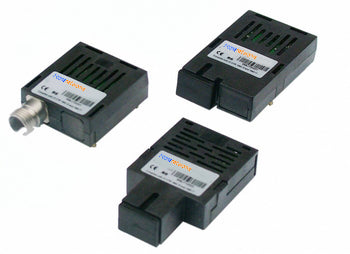
HFBR-1521Z | HFBR-2521Z | AFBR-1629Z | HFBR-2629Z AVAGO compatible full series
-
HFBR-1531Z,HFBR-2531Z,HFBR-1531Z 100% Compatible with Avago ,HFBR-2531Z 100% Compatible with Avago
Regular price $0.00Regular price -
AVAGO HFBR-2521ETZ Compatible Domestic Alternative Optical Module
Regular price $0.00Regular price -
AVAGO HFBR-1521ETZ Compatible Domestic Alternative Optical Module
Regular price $0.00Regular price -
AVAGO HFBR-1528Z Compatible Domestic Alternative Optical Module
Regular price $0.00Regular price


Power and Wavelength Testing
Test the signal delivering strength and wavelength, to ensure the signal decoding capacity of the receiver, and the wavelength remains consistent from the transmitter to the receiver.

Traffic Testing
Test the bit error rate and packet loss rate, to make them meet the corresponding standards and ensure the performance of transceivers.

Optical Performance Testing
Test the transceivers' eye diagram situation, receiving sensitivity, extinction ratio, wavelength, light-emitting, light-receiving, current and voltage, to ensure the signal quality, stability and reliability of the transmission.

End Face Testing
Check the end face of the transceivers and keep them clean for more stable data transmission, better performance, and durability.

Various Switch Tests
Every module is quality tested for compatibility in the multi-brand switches environment, guaranteeing flawless operations.